Misuses of global citizenship education: new nationalisms and curriculum policies.
Examining policies from the UK (England, Scotland and Wales) and New Zealand.

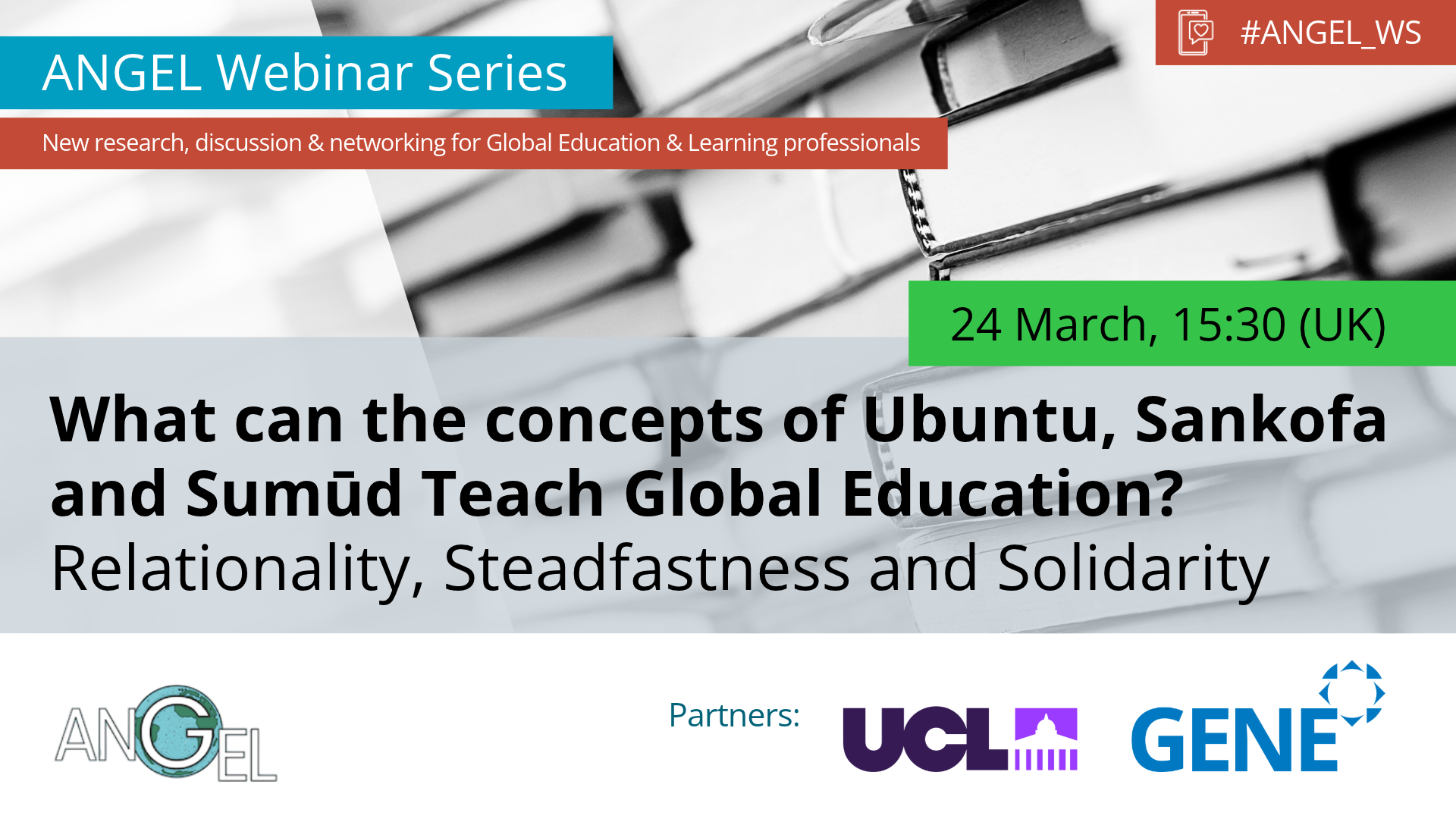
This webinar brings the concepts of Ubuntu, Sankofa and Sumūd into dialogue to explore decolonial approaches to Global Education. Grounded in southern African, Ghanaian and Palestinian knowledge traditions, the session considers relationality, shared humanity, historical consciousness, steadfastness and resistance, asking how these perspectives can challenge Eurocentric epistemologies and support more just and ecologically grounded approaches to Global Education.
Global Education engages learners with complex and interconnected global issues, from social and economic inequalities and conflict to climate change, environmental degradation and questions of justice and solidarity. How these issues are understood, however, depends on the knowledge systems, values and ways of relating through which we make sense of the world. Dominant approaches to Global Education have often privileged Eurocentric epistemologies, limiting the perspectives through which global challenges and possible responses to them are understood.
This webinar explores decolonial approaches to Global Education through a dialogue between Ubuntu, Sankofa and Sumūd. It centres these as situated knowledge traditions in their own right, while asking what their recognition reveals about whose knowledge is represented, valued and legitimised within Global Education.
Ubuntu, rooted in southern African philosophical traditions, foregrounds the relational nature of human existence and emphasises shared humanity, mutual responsibility, dignity and obligations towards others. Within education, Ubuntu offers ways of thinking that move beyond individualism towards relationality, community and collective flourishing.
Sankofa, originating in Akan thought and commonly understood through the idea of “going back to retrieve,” foregrounds the importance of engaging with history and learning from the past in shaping the present and future. Within this conversation, Sankofa opens space to consider historical consciousness, collective memory and the importance of understanding contemporary global issues in relation to the histories that have shaped them.
Sumūd, commonly translated as steadfastness, is grounded in Palestinian histories and experiences of dispossession, occupation and resistance. It encompasses more than endurance or resilience: it involves dignity, rootedness, cultural continuity, collective agency, care and resistance to erasure. As an educational concept, Sumūd draws attention to how hope and agency can be sustained through relationships, storytelling, memory, land and collective struggle.
The conversation will bring together perspectives from Palestine, Ghana and South Africa. Kefah Barham will draw on her research on Sumūd and Global Citizenship Education in the occupied West Bank, exploring how Palestinian lived realities shape understandings of global citizenship, resistance, solidarity and justice. Simon Eten will bring perspectives from the Ghanaian context, including Sankofa and its emphasis on historical consciousness and learning from the past. Anielka will draw on her doctoral research on Global Education in South Africa to consider the significance of African epistemologies for challenging Eurocentric assumptions and rethinking how knowledge is recognised within Global Education.
Bringing these perspectives into dialogue creates space to explore decoloniality not simply as the inclusion of previously marginalised concepts within existing educational frameworks, but as a questioning of the epistemological assumptions through which knowledge itself is recognised and valued. While grounded in different histories and contexts, Ubuntu, Sankofa and Sumūd bring relationality, historical consciousness, memory, rootedness and resistance into conversations about Global Education, opening possibilities for different ways of knowing, being and relating.
The dialogue also opens an important ecological dimension. Relationships with community, place, land and the more-than-human world are significant within the knowledge traditions and educational practices being discussed. This creates opportunities to bring Global Education into closer conversation with Education for Sustainability and to consider socio-ecological justice through relational and place-based perspectives. The session will explore how questions of environmental sustainability are inseparable from histories of colonialism, dispossession, relationships with land and struggles for justice.
Across these strands, the three perspectives invite critical consideration of solidarity, responsibility, historical consciousness, resistance and collective action. They raise questions about whether solidarity can be understood primarily as empathy with distant others, or whether Global Education needs more relational, historically informed and politically grounded approaches that recognise interconnected responsibilities and unequal relations of power.
The webinar will therefore explore three interconnected questions:
The 90-minute session will combine contributions from the three speakers with dialogue between speakers and participants. Participants will be invited to reflect critically on the epistemologies informing their own research and educational practice and to consider how Global Education can create greater space for knowledge traditions and perspectives that have historically been marginalised within the field.
The webinar is intended for researchers, educators, practitioners and postgraduate students working in Global Education, Global Citizenship Education and Education for Sustainable Development, as well as those interested in decolonial approaches to education. It will be relevant to those exploring how diverse epistemologies and knowledge traditions can inform educational responses to global challenges, including questions of social and ecological justice, solidarity, resistance, relationality and collective responsibility. The session will also be of interest to teacher educators, curriculum developers and policymakers seeking to engage with African and Palestinian perspectives within Global Education research and practice.
This event is part of a series of online events run by the Academic Network for Global Education & Learning. The series is aimed at Global Education professionals, as well as anyone with an interest in research in the fields of Development Education, Global Citizenship Education, Human Rights Education, Education for Sustainable Development, Education for Peace, and Intercultural Education. The events are free, but you will need to register.

Use our platform to reach our diverse and international audience of researchers, practitioners, and policymakers
Carousel image attribution: "panoramio (2525)" by William “Patrick” Ma. Under CC 3.0
The establishment of this network and website has been made possible with funding support from the European Commission.
The activities and publications of the network are the responsibilities of the organisers, the Development Education Research Centre, and can in no way be seen as reflecting the views of the European Commission.