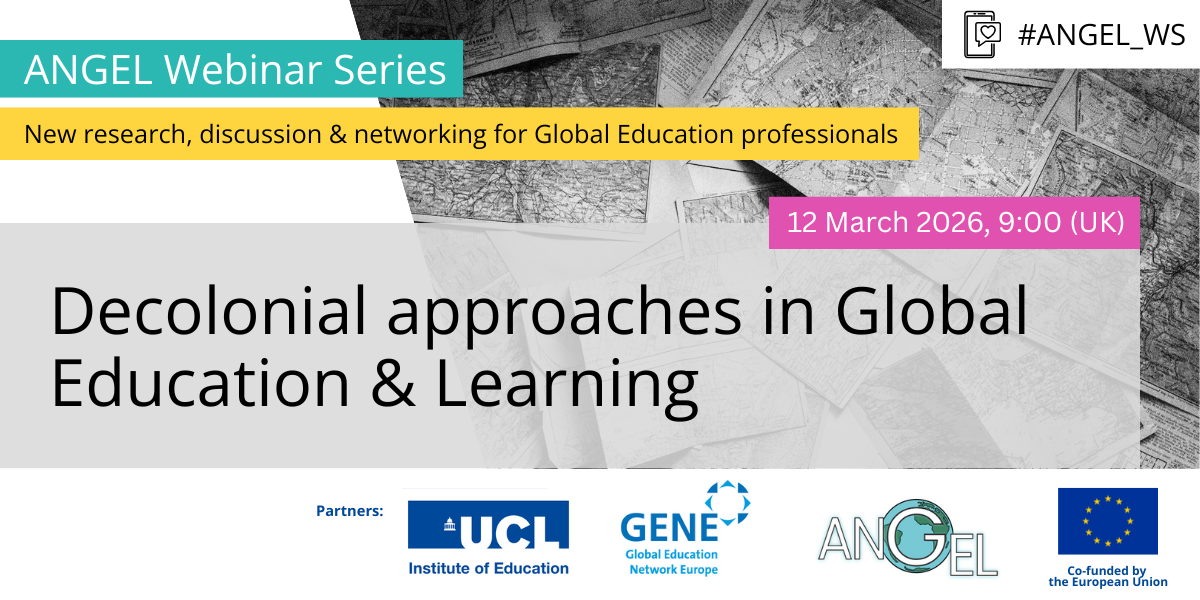
Decolonial approaches in Global Education & Learning
Summary
Decolonality has become an important theme of research and praxis within global education and learning in recent years, with a growing number of submissions to ANGEL events that focus on this topic. The webinar will feature 3 short presentations that highlight diverse aspects of this important and emerging field of enquiry.
Presentations
Decolonising the educational mindset: Nordic perspectives. (Joffy Conolly, University of Oulu, Finland)
- Drawing on research from four Nordic countries, the presentation highlights a shared history of colonial complicity and ongoing coloniality toward Indigenous and minoritised groups. Using decolonial theory, I show that Nordic ideals of equality rest on an imagined sameness that obscures diversity, particularly in education, where reluctance to address race, white supremacy, and inequality sustains a singular historical narrative and marginalises minority perspectives. To challenge this, I will outline some recent teaching initiatives aimed at decolonising Nordic education, offering practices relevant to policymakers and educators confronting similar issues globally.
A Call to Engage Culturally Diverse and Migrant Youth in Transformative GCE Research. (Ana Radović, Queensland University of Technology, Australia)
- This presentation discusses the methodology used in a study focused on culturally diverse migrant youth perspectives and experiences of citizenship and GCE in Australia. The study explored methodological possibilities of the transformative paradigm in the GCE research. The presentation is also a call to the research community to actively seek and embed culturally diverse and migrant youth perspectives in GCE. Engaging with their voices can provide meaningful, and important insights into what matters to young people and how they understand and envision citizenship.
Decolonising Education for Sustainable Development (ESD): A Progressive Framework for Global Justice and the Sustainable Development Goals (SDGs) in Schools. (Subin Nijhawan, Goethe University Frankfurt, Germany)
- This presentation, based on my recent study, explores how education for sustainable development (ESD) offers a decolonial and transformative framework for addressing global challenges. Grounded in the sustainable development goals (SDGs), especially SDG 4 on quality education, the study critiques Eurocentric paradigms and highlights the urgency of embedding global justice, sustainability, and equity into educational frameworks. Drawing from the future Federal German conceptual framework for ESD (“Orientierungsrahmen”), this paper pleas to transcend rigid subject boundaries and promote participatory, transdisciplinary pedagogies as a full-fledged reform of current school systems. The analysis employs a progressive reading of ESD to demonstrate how schools can navigate within systemic constraints focusing on diametrical comparativist approaches like PISA. The teaching example, “Global Justice: Climate Lawsuits and Border Regimes,” illustrates the ESD’s potential to empower students as global citizens, capable of addressing climate justice and human rights issues in a globalized context. By fostering critical thinking and cultural reflexivity, this approach challenges nation-centric models and equips learners with the tools to engage in genuine decolonial practices. The findings underscore the need for systemic reforms to ensure that ESD realises its revolutionary potential as a catalyst for sustainability, equity, and human rights in education worldwide.
Audience
Researchers and practitioners
Format
This event, to be held at 9:00 (UK) on the 12th March 2026, will last around 90 minutes and will be hosted via Zoom. The event will be in English. Please register via Zoom using the button on this page. The event will be Chaired by ANGEL Co-Chair Doug Bourn.
Speakers
- Joffy Conolly is a teacher and doctoral researcher at the University of Oulu, Finland. His doctoral research examines the colonial and human-centric assumptions inherent in critical thinking. Other research areas include student mobility, Nordic and global education. Through his work, he hopes to stimulate greater discussion in education and society about how we can approach and think differently about global problems, particularly sustainability.
- Ana Radović is a PhD Candidate in the School of Education, Faculty of Creative Industries, Education and Social Justice at the Queensland University of Technology. Ana has over ten years of international experience in youth and community engagement and education, as well as in civil rights education and migration support. Her research interests include cultural and epistemic inclusion and social justice in global education, and migration research. She is also an advocate for the inclusion of marginalised voices in research through the transformative paradigm.
- Subin Nijhawan is research associate at the Institute of English and American Studies, Goethe University Frankfurt. His main research interests gravitate around multilingualism & sustainability, language learning and artificial intelligence as well as around participatory research methods in education. From 2021-2025, he acted as one of the elected chairs of the expert group for the Social Sciences and Political Education with the The Standing Conference of the Ministers of Education and Cultural Affairs in Germany (KMK) and the Federal Ministry for Economic Cooperation and Development (BMZ), for designing a conceptual framework for global education and ESD.
The ANGEL Webinar Series
This event is part of a series of online events run by the Academic Network for Global Education & Learning. The series is aimed at Global Education professionals, as well as anyone with an interest in research in the fields of Development Education, Global Citizenship Education, Human Rights Education, Education for Sustainable Development, Education for Peace, and Intercultural Education. This event, along with the other activities of the ANGEL network, is co-funded by the European Union.**
** The establishment of this network and website has been made possible with funding support from the European Commission. The activities and publications of the network are the responsibilities of the organisers, the Development Education Research Centre, and can in no way be seen as reflecting the views of the European Commission.